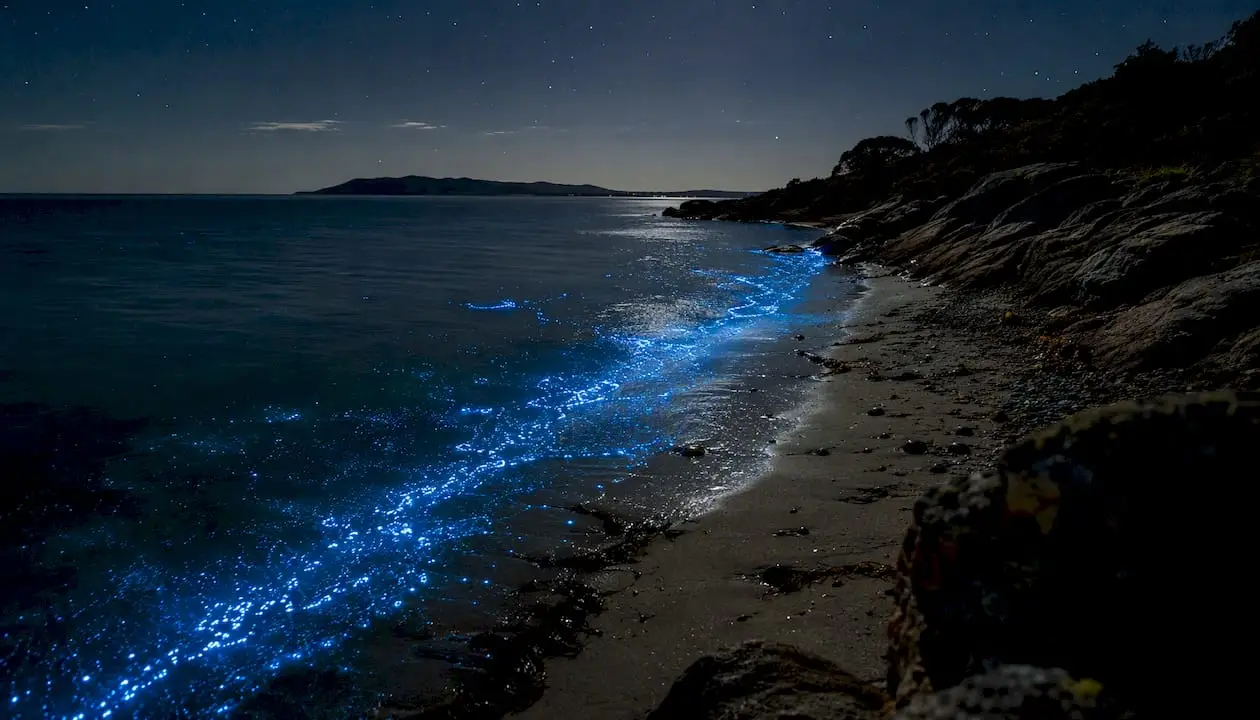
Yes, Tasmania glows. Marine bioluminescence, often called sea sparkle, appears reliably along the state’s south-east coast, and if you time it right, you’ll see the water itself light up electric blue with every wave, paddle stroke or footstep through the shallows. The culprit is nearly always Noctiluca scintillans, a tiny dinoflagellate that blooms in Tasmanian waters when conditions align, typically during warmer months.
Start your search in these three places:
- Derwent Estuary and the Hobart waterfront — particularly Montagu Bay and Bellerive, both a short drive or ferry ride from the city.
- Bruny Island — quieter beaches with less light pollution, a favourite for photographers chasing a clean, dark shoreline.
- Eaglehawk Neck and Port Arthur — on the Tasman Peninsula, roughly 90 minutes from Hobart, where sheltered coves regularly report strong displays.
Here’s the honest bit: this is a natural phenomenon, not a scheduled show. Treat any bioluminescence sighting as opportunistic. Check local reports before you drive out, and read on for exactly how to do that.
Key Takeaways
Tasmanian bioluminescence is real, driven mainly by Noctiluca scintillans, and most reliably viewed on dark summer nights in sheltered bays like Montagu Bay, Bellerive and Bruny Island after confirming recent local reports.
| Point | Details |
|---|---|
| Yes, it’s here | Noctiluca scintillans produces regular sea sparkle displays along Tasmania’s south-east coast. |
| Best first spots | Try Montagu Bay, Bellerive, Bruny Island, and Eaglehawk Neck before travelling further afield. |
| Best conditions | Aim for dark, moonless summer nights with water around 18–22°C and a gentle onshore breeze. |
| Verify before you go | Check the Derwent Estuary Program and local community groups for time-stamped sightings. |
| Pair it with a local tour | Aussie Loop’s Hobart and Bay of Fires experiences fill the evening whether or not the glow appears. |
Table of Contents
- What causes bioluminescence in Tasmania?
- Where to see bioluminescence around Tasmania
- When is the best time to see bioluminescence in Tasmania?
- How do I check if there’s bioluminescence in Tasmania right now?
- How do you view bioluminescence safely and responsibly?
- Why bioluminescence blooms are changing in Tasmania
- Why Aussie Loop pays attention to what the water is doing
- Book a Tasmanian evening that doesn’t depend on luck alone
- Where to learn more
- Sources
- FAQ
What causes bioluminescence in Tasmania?
Bioluminescence is light produced by a living organism through a chemical reaction, and in Tasmanian coastal waters, that organism is almost always Noctiluca scintillans, a single-celled dinoflagellate roughly the size of a grain of table salt. During the day, dense concentrations of Noctiluca can turn the water a rusty pink or red, an effect commonly (if inaccurately) called a “red tide.” At night, the same cells produce a cold blue flash when they’re physically disturbed, by a breaking wave, a swimming fish, a kayak paddle or your own footstep in the shallows.
The mechanism itself is a bioluminescence reaction similar to what powers glow-worms and deep-sea jellyfish, where an enzyme called luciferase triggers light on contact or agitation. It’s worth knowing that Noctiluca isn’t the only bioluminescent organism you might encounter around Tasmania. Certain jellyfish, some deep-water fish, and even squid species can produce light through similar chemistry, though none appear in the shallow, shore-visible blooms that make Tasmania’s coastline famous.
The pattern is almost always the same: a still, glassy slick sits on the surface during the day, then the slightest agitation, a hull, a hand, a rolling wave, sets off a scatter of blue sparkles that outlines the movement itself.
That visual, movement traced in light, is what makes this phenomenon so different from watching stars or the aurora. You’re not observing a fixed light source. You’re triggering it.
Where to see bioluminescence around Tasmania
Location matters more than almost anything else here, because Noctiluca blooms concentrate in sheltered water and thin out fast once you leave it. These are the spots that come up again and again in local sightings and reporting.
- Montagu Bay and Bellerive — on Hobart’s eastern shore, sheltered from the prevailing westerlies that dominate Tasmanian weather. Easy to reach by car or the Bellerive ferry, and popular enough that you’ll often find other bloom-chasers already scanning the water when conditions are right.
- Hobart waterfront — right in the city, meaning less driving but more streetlight glow to contend with. Best on a clear, dark night away from the wharf lighting.
- Eaglehawk Neck and Port Arthur — Tasman Peninsula coves with genuinely dark skies and regular reports through summer. Worth the drive if you’ve confirmed recent activity.
- Bruny Island — some of the darkest, least developed shoreline within easy reach of Hobart, particularly around Adventure Bay. The ferry crossing adds planning time, but the payoff is a shoreline with almost no competing light.
- Sandy Bay, Howden, and Seven Mile Beach — all popular southern stretches with easier access than the peninsula, though they can pick up more ambient light from nearby suburbs.
From shore, you’ll usually see the glow as a faint blue shimmer tracing the wave line; from a kayak or small boat, disturbed water around the hull can throw up a genuinely dazzling scatter. Access is straightforward at all the Hobart-adjacent spots; Bruny Island and the peninsula require a bit more travel time but reward you with darker skies.
Pro Tip: Pick a sheltered bay or headland with a gentle onshore breeze rather than open coastline. Onshore winds concentrate Noctiluca cells near the shore, while offshore winds push blooms back out to sea, according to field observations from local sea sparkle chasers.
Before you drive an hour to the Tasman Peninsula on a hunch, check recent local reports. It’s a five-minute step that saves a wasted evening.
When is the best time to see bioluminescence in Tasmania?
Your best odds come on dark, moonless nights in summer, when coastal water temperatures sit roughly in the range favourable for blooms. Noctiluca is present in Tasmanian waters year-round, but the dense blooms that produce a genuinely striking display tend to build through the warmer months and can persist for around three to four weeks at a time once conditions favour them.
Several environmental factors line up to create a strong night:
- Warm water — the 18–22°C range appears consistently in scientific tracking of Tasmanian blooms.
- Calm seas — choppy, wind-whipped water disperses the bloom and dilutes the effect.
- Little to no moonlight — a bright moon washes out the glow almost entirely, so plan around the new moon where you can.
- Low shore light pollution — streetlights and car headlights ruin your night vision and compete with a light source that’s genuinely faint up close.
- A gentle onshore breeze — this holds the bloom near the coast rather than letting it drift offshore.
Summer is your best statistical window, but it isn’t the only one. Noctiluca doesn’t disappear in winter, it simply blooms less densely, so a mild autumn evening with the right water temperature can still produce results. Latitude and local currents shift the exact timing year to year, which is exactly why real-time checking matters more than a fixed calendar date.
How do I check if there’s bioluminescence in Tasmania right now?
Run through this sequence before you commit to a night out, in this order:
- Check the Derwent Estuary Program’s updates. They monitor water quality across the estuary and post when notable Noctiluca activity is occurring, making them one of the most reliable sources for current bioluminescence status.
- Scan the Bioluminescence Tasmania community group. This local Facebook group is where most sightings get reported first, often within hours of someone spotting a glow.
- Look at IMOS and IMAS updates. Australia’s marine observing network occasionally publishes bulletins on Noctiluca range and bloom activity that add useful scientific context to what you’re seeing reported locally.
- Call a local visitor centre or tour operator. If you’re staying near Hobart or the Tasman Peninsula, a quick phone call to a local operator can confirm whether anyone has seen activity in the past 24 to 48 hours.
- Verify with time-stamped evidence. Look specifically for photos or posts dated within the last day or two. Older bloom photos get re-shared constantly on social media, and a photo from three weeks ago tells you nothing about tonight’s conditions.
This isn’t a phenomenon you can set a calendar reminder for. Local reporting site 7NEWS puts it plainly: blooms are unpredictable and can vanish as quickly as they arrive, so a fresh sighting today is worth more than any seasonal guideline.
How do you view bioluminescence safely and responsibly?
Watching the water light up is genuinely one of the most memorable things you can do on a Tasmanian evening, but a few habits make the difference between a great night and a disappointing or damaging one.
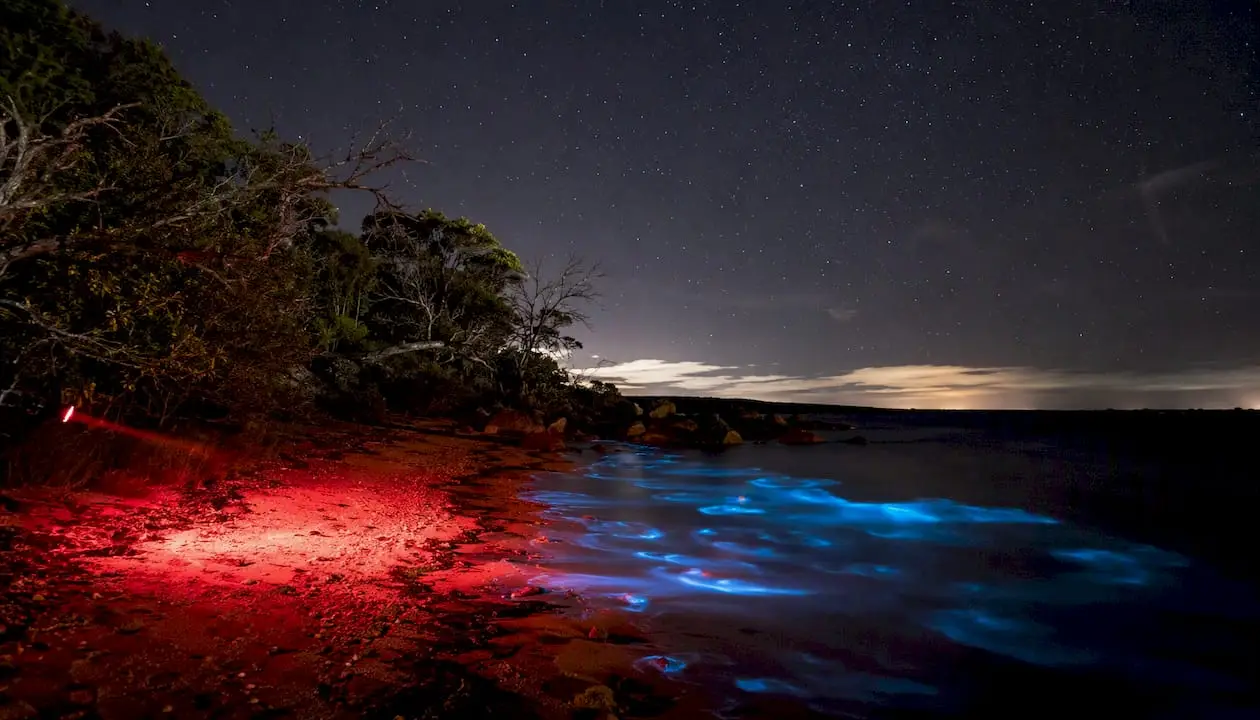
Keep your light use to a minimum. Bright torches and phone screens wreck your night vision and drown out the very glow you’re trying to see, so switch to a red-filtered torch if you need one at all. Keep noise down near the shoreline, both for the wildlife around you and for other people quietly waiting for their eyes to adjust. Never scoop up water or organisms to “test” the glow in a bottle; the display only works in situ, and collecting marine life disturbs a fragile part of the food chain.
On safety, the Derwent Estuary Program is clear: the display itself is generally not harmful to swim near, though swimming directly through a dense bloom can cause minor skin irritation for people with sensitive skin. If that applies to you, watching from the shallows or a boat rather than swimming through the thick of it is the sensible call.
Kayaking gives you the most dramatic view, since every paddle stroke throws up a trail of blue light, but it requires real paddling competence and lights-off discipline once you’re on the water. If you’re heading out by boat instead, slow, quiet drifting beats speed every time; a fast hull churns up light but also scares off the very stillness that makes the scene magical. Wherever you’re standing or paddling, avoid trampling shoreline vegetation, pack out everything you bring, and respect any signage or seasonal closures around sensitive coastal habitat.
Why bioluminescence blooms are changing in Tasmania
Noctiluca blooms aren’t random. They’re driven by population dynamics, food availability and shifting ocean conditions, and one driver stands out above the rest: the southward push of the East Australian Current. IMOS ocean monitoring data documents a genuine range expansion of Noctiluca into Tasmanian waters since the 1990s, when the species was first recorded locally, linked to a mix of warming water, altered current patterns and, in some cases, ship-borne transport of cells into new areas.
Tasmania’s own Department of Natural Resources and Environment identifies Noctiluca as the most common cause of red tide events in the state, tying occurrences directly to the same current shift.
| Factor | Typical range or pattern |
|---|---|
| Favourable water temperature | 18–22°C |
| Typical bloom duration | 3–4 weeks |
| First Tasmanian records | 1990s |
| Key oceanographic driver | East Australian Current shifting south |
The blooms are a spectacle, but they’re also a signal worth taking seriously. Scientist Lisa-ann Gershwin has warned via ABC News that large, sustained blooms can strip oxygen from the water and compete with other marine species for food, effects that ripple into local aquaculture operations working in confined pens near affected coastlines. Watching the glow is one thing. Understanding that it’s tied to a warming coastline undergoing real ecological change is another, and both belong in the same conversation.
Why Aussie Loop pays attention to what the water is doing
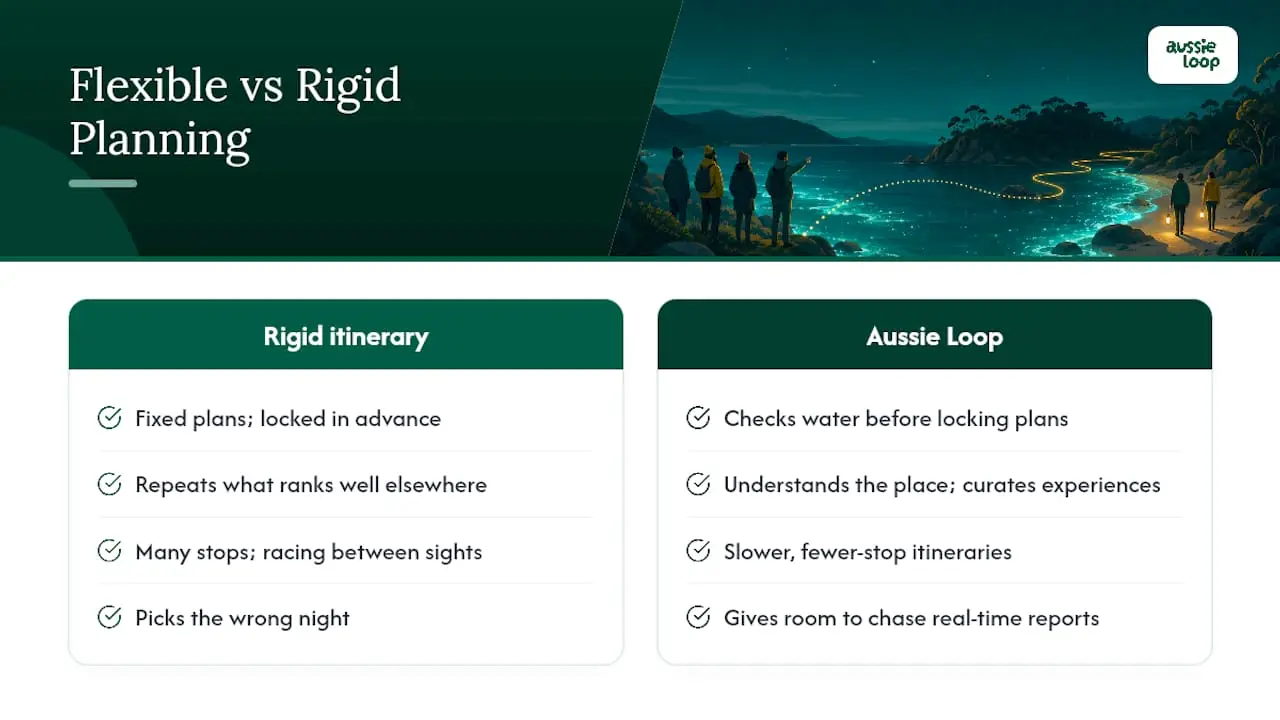
I’ve come to see bioluminescence coverage as a useful test of whether a travel guide actually understands a place or is just repeating what ranks well elsewhere. Tasmania’s coastline doesn’t reward a rigid itinerary. It rewards flexibility, and a willingness to check the water before locking in plans, which is exactly the approach Aussie Loop takes when curating experiences in the state.
The mistake most visitors make isn’t picking the wrong location, it’s picking the wrong night. You can stand at the perfect bay on the Tasman Peninsula and see nothing, simply because the bloom drifted offshore on an unfavourable wind two days earlier. That’s not a failure of research; it’s the nature of a living ecosystem that doesn’t run on a booking calendar. Aussie Loop’s approach to Tasmania leans into that reality rather than pretending it away, favouring slower, fewer-stop itineraries that give travellers room to chase a real-time report instead of racing between fixed attractions.
The bigger point, and one worth sitting with, is that Tasmania’s most compelling natural moments are often the ones nobody can promise you. That’s not a flaw in the destination. It’s the reason a good local guide, human or otherwise, still matters more than a search result.
Book a Tasmanian evening that doesn’t depend on luck alone
Bioluminescence can’t be scheduled, but the rest of your Tasmanian evening can. Aussie Loop is the alternative to piecing together your own itinerary from scattered blog posts. It gives you locally vetted experiences that fill the hours either side of a bloom check, so a quiet night on the water still turns into a memorable one.

Pair your bioluminescence outing with the Tasmanian Seafood Seduction Cruise around Hobart’s waterfront, a genuinely good way to spend the hours before dusk while you wait on a sighting report. If you’re heading further afield, the Bay of Fires day tour or the longer three-day Bay of Fires experience both work well alongside a coastal bloom-chasing evening, and both come with local guide knowledge, a proper safety briefing, and small group sizes rather than a packed coach.
Because sightings are genuinely opportunistic, book flexible dates where you can and ask about cancellation terms before you pay, particularly for anything timed specifically around an evening viewing. Start browsing Aussie Loop’s Tasmanian tours and build an evening worth having, glow or no glow.
Where to learn more
- Derwent Estuary Program — the best source for real-time updates and safety guidance on Hobart-area blooms.
- IMAS zooplankton image key — scientific background on Noctiluca scintillans and its role in Tasmanian waters.
- IMOS ocean report on Noctiluca — data on the species’ southward range expansion and oceanographic drivers.
- Tasmanian Department of Natural Resources and Environment — government-level tracking of algal blooms across the state.
- ABC News and 7NEWS — ongoing media coverage with expert commentary and current viewing spots.
Sources
- Noctiluca scintillans (IMAS, UTAS)
- Bioluminescence | Derwent Estuary Program
- Noctiluca (IMOS ocean report)
- Tasmania’s south‑east coast ‘glows’ with bioluminescent algae (ABC News)
- Tasmania’s glowing coastline: How to spot bioluminescent magic (7NEWS)
FAQ
Where can I find bioluminescence in Hobart?
Montagu Bay and Bellerive, on Hobart’s eastern shore, are the most consistently reported spots, with the Hobart waterfront itself also producing sightings on darker nights.
What time of year is best for bioluminescence in Tasmania?
Summer offers the strongest odds, when coastal water temperatures typically reach 18–22°C, though Noctiluca is present year-round and sightings can occur outside that peak window.
Is there bioluminescence in Hobart right now?
There’s no way to guarantee it on any given night. Check the Derwent Estuary Program’s updates and the Bioluminescence Tasmania community group for recent, time-stamped reports before heading out.
Which month gives the best chance of seeing bioluminescence in Tasmania?
The warmer months of December through February give the best statistical chance, since that’s when water temperatures most often sit in the 18–22°C range that favours strong blooms.
Do I need a tour to see bioluminescence in Tasmania?
No, most sightings happen from public shorelines you can access yourself, though a locally guided evening through a platform like Aussie Loop can fill the waiting time with a worthwhile activity either way.